This is a burndown chart that i created. it shows that for the next 4 weeks I will be putting in a lot of hard work. I plan on researching 3d animation in games, I will look at Sophie Taubers puppets and i will create my own Dada styled puppet that i was inspired by when looking up Tauber's work. As you can can see from the chart above the blue line represents the ideal this means when i would like to get the work done by. The red line represents the reality this means when the work has to be done by. As you can also see from the chart there isn't any big gap until week 3. week 3 is when i should be making my animations, There is a big gap here because i'm not really that used to blender so i think i will need more time when making my animations.
For the legal and ethical. I have created all the puppets on my own using the software bender. If this these were real animations and I was to take someone else's assets, I would have to mention that I took them otherwise that person could sue me. If my animations were to feature an asset where an event happened for example an attack I would have to remove that asset from my environment. Another case for legal and ethical would be if my animations featured any nudity or explicit content I would have to make it an 18 rated animation because that is against discrimination.
When rendering my animations I rendered them through the CUDA GpU setting, I chose to do this setting because my GPU is more updated while my CPU is out of date by a couple of years. When rendering the animations I rendered them as AVI JPEG.
This is a breakdown of my walking cycle that i plan on making with my puppet. I think this will be an easy animation
This is a breakdown of my running cycle that i plan on making with my puppet. I think this will be an easy animation. It will be my walking cycle only faster
This is a breakdown of my spinning cycle that i plan on making with my puppet. I think this will be an difficult animation to make because i have to make my puppet rotate
This is a breakdown of my Dancing cycle that i plan on making with my puppet. I think this could be a difficult animation because I have to make the puppet do different moves than just walking.
To conclude this task I believe I have made the storyboards for my animations to the best of my ability. I used the basic shapes that are used in powerpoint to create the puppets I will be creating. When making another story board I will try and use a different and more difficult software like powerpoint.
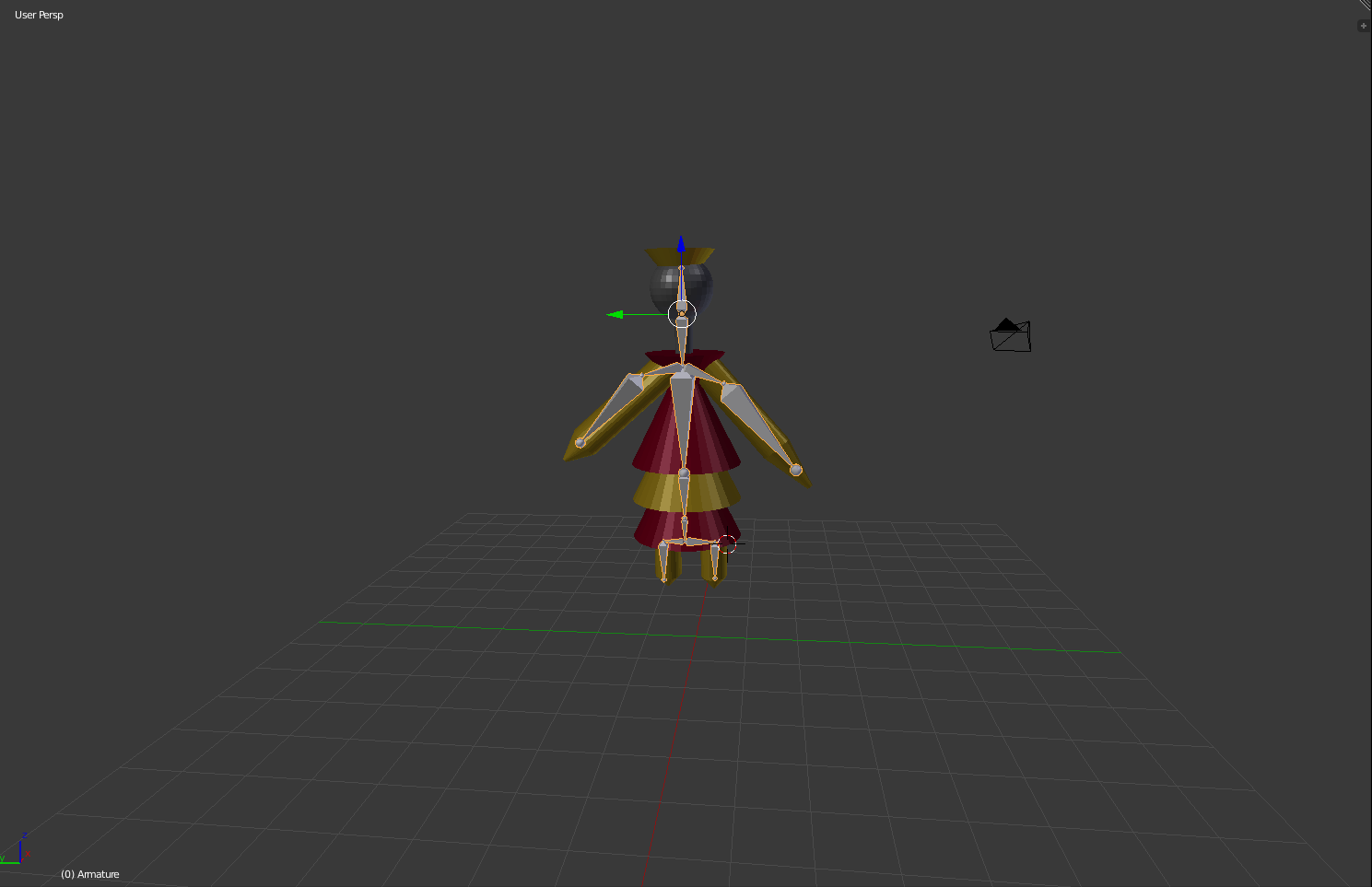
When rigging my puppet I first added an armature at the head and then started to extrude the bones. To pair the puppet to the bones I clicked on the mesh and then the bones and then paired them together so that when I select a bone and rotate the bone, it looks like my puppet is moving.
The puppet that I have made is made out of 5 cones,5 cylinders and 1 sphere. When creating my puppet I took reference from one of Taubers Dada puppets.
For this assignment I think I have fulfilled every task to a certain level within the uniT, I think i have learnt some new skills and ways of using the blender software which will allow me to use the skills in the future. The skills I have learnt are things such as rigging, skinning , key framing and modeling. When modeling I am quite pleased with my finished products as I didnt really know much about blender when starting the unit. I have put alot of time and effort into this unit that I have really enjoyed modeling and creating assets for the style I didnt really know much about. I think that if i was to do a unit like this again I would be able to complete it in a better standard and with more details given the skills I have learnt. When researching about the dada style I didnt really understand what it was I was looking for other than a bunch of simple shapes all together to make a simple picture. When researching Sophie Taeuber's work I really enjoyed what i was looking for because i came across some really good pieces of art. I really enjoyed looking at the different puppets that she made with some simple and basic shapes.
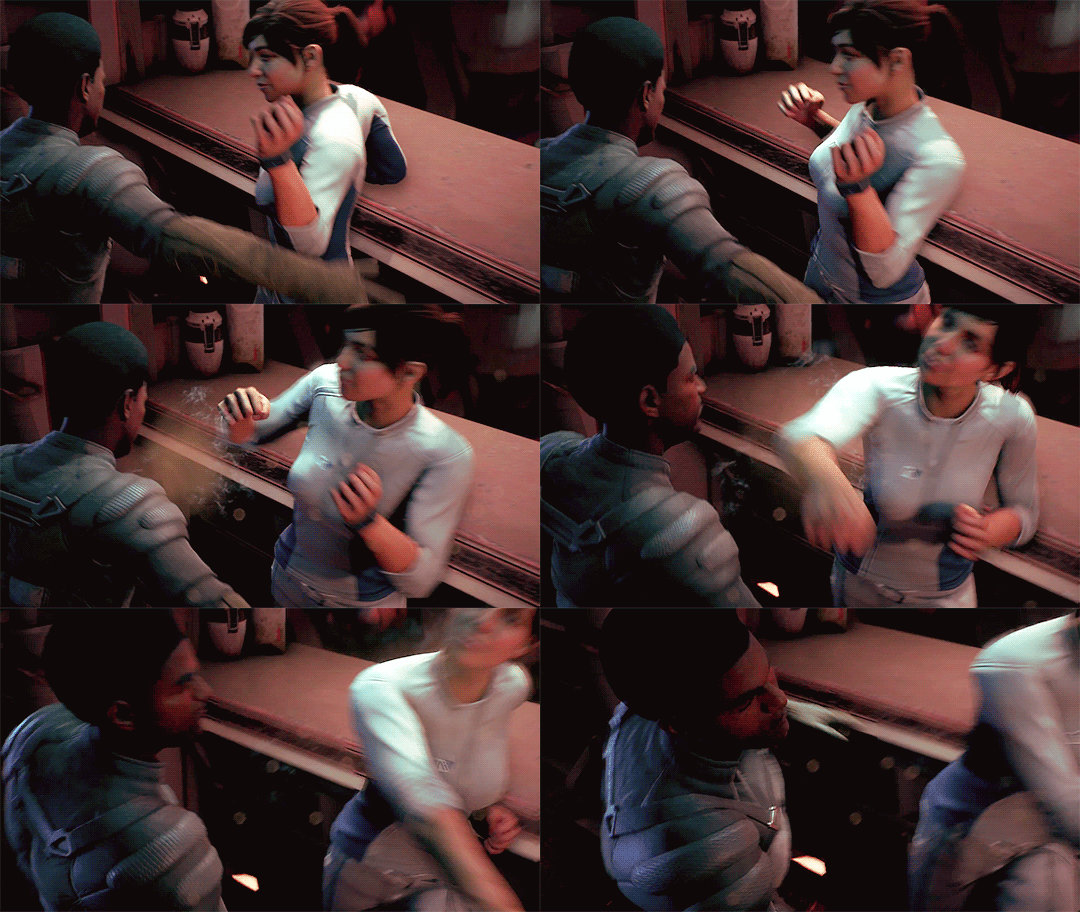
When using 3D animation in a game you want to make sure that you are animating your assets correctly, for example in the 2017 game Mass Effect Andromeda which was made by Electronic Arts the animation in that game was hyped up for about 2 years and the game was a fail when it came to the games animations.
For example in this part of the game your character is supposedly punching someone in the face however as you can see from the image above you character is punching midair and the enemy is reacting to it.
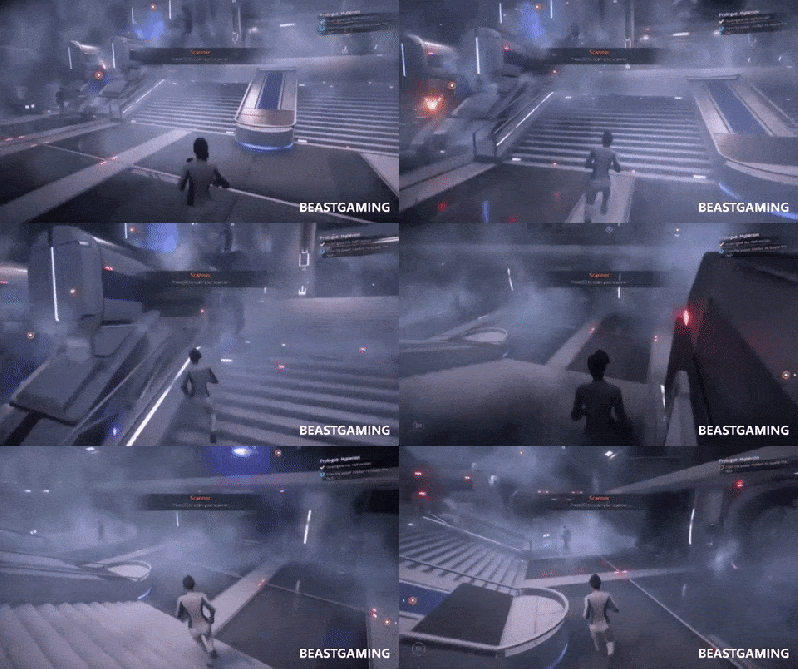
Another example of bad animation used in Mass Effect Andromeda is the image below which is showing you how the character runs in the game. However this example was a bug and hasn't been fixed.
Another example for a game that has used bad animation is the Assassins Creed series.
In the example below it shows a facial animation on the Assassins Creed 2 Remastered.The game was supposed to be remastered to HD graphics, instead the game looks like it has been downgraded.
Another example of bad animation used in the Assassins Creed series was featured in the Assassins Creed Unity game. In the example below the main characters face has disappeared leaving only the character's eyes and mouth
Good animations
In the example below it shows an animation reel from the game Horizon Zero Dawn. The reel shows what the environments wildlife is like and how they interact as you move around. As you can see the developers did a really good job at making the animals move like animals within the real world.
DADA is a type of style that a group of artists used in the early 20th century who accidentally exploited effects in their work.
Sophie Taeuber was a swiss artist of the 20th century. Sophie Taeuber is now recognised as one of the key figures in the Dada artists. Taeuber experimented with numerous styles from grid work to free flowing geometric shapes.
This example of Dada which is known a L.H.O.O.Q. is was created by artist Marcel Duchamp. The piece was created in 1919. L.H.O.O.Q. is a cheap production of the famous Leonardo Da Vinci's work The Mona Lisa.
The above images are some examples of Sophie Taeubers work. A you can see,her work uses style dada. Her work seems to be very simple as this is mostly just a bunch of shapes that make out to be a puppet.
3D in games The first ever 3D game was 3D Monster Maze which was released on a commercial games machine. It was developed by Malcolm Evans 1981 for the Sinclair ZX81 platform. The game awarded points for each step the player took without getting caught by the Tyrannosaurus Rex that hunted them in the 16 by 16 cell.
In the fifth generation the most 3D games started to be more released. While there were games prior that had used three dimensional environments, such as Virtual Racing and Star Fox, In star Fox the environment was made up of space projectiles like other spaceships and buildings.
With the power of what 3D games can now produce people were able to make huge worlds for players to explore like skyrim.With a full open world 3D game with graphics that were mindblowing for the time especially on the PC skyrim shows just how much both the technology to run games has improved and how much better they run,Tthe people would have never dreamed of a game such as skyrim
3D in Films
The first 3D animation in a film was in the 1976 movie called Futureworld, where A 3D animation of a rotating palm and face made of polygons is shown. This was actually the world's first 3D animation rendered in 1972.
In this era people are now able to create 3D spectacular movies like Avatar which was one of the most amazing films in 2009, Avatar was that one film for people to show off what they can really create when it comes to 3D and CGI
3D in TV
3D in medicine
3D is used in medicine for CT scans they can create a model of the inside what they scan and then look at the inside and determine what's up with the patient
3D in engineering
3D is used in engineering to create a model of what they want to make before they make it and test certain pressures on the construction and see if it holds up
3D in architecture
3d in architecture is used to show off the blueprints off a building before it gets built.
Displaying 3D Polygon Animations
API Games use software known as an API (Application Programme Interface) which is a set of tools for building software applications a good API makes it easier for the software to be developed as it gives you all the building blocks you need to make the software you're trying to make. The Graphics pipeline The graphics pipeline is the way that a computer transferees the mathematical data that it has on the object into the object that we see on the screen the 3D graphics pipeline typically takes a 3D object when it's in data and converts it into a 2D raster image Open GL and direct 3D both have very similar graphics pipelines
Stages of the graphics pipeline First the scene is created out of geometric primitive shapes this is usually done using triangles as they are good for this as they always exist on a single plane. After this stage comes the modelling Modelling and Transformation
This stage transforms the local objects consternates into the 3D world coordinate system
Next it transforms the 3D world Coordinates into 3D Camera Coordinates with the camera as the origin
Illuminates according to the lighting and reflectiveness of the object for example if the room as pitch black the objects will be seen as black
This stage transfares the 3D coordinates into a 2D view of the camera a object further away from the camera looks smaller and one's that are closer up look larger this is caused by the x and y coordinates of each of the objects being divided by it's z coordinate (this represents it's distance from the camera) in orthographic projection objects retain there original size regardless of distance from the camera.
Geometry Theory
The basic object used in mesh modeling is a vertex, a point in three dimensional space. Two vertices connected by a straight line become an edge. Three vertices, connected to each other by three edges, define a triangle, which is the simplest polygon in Euclidean space. More complex polygons can be created out of multiple triangles, or as a single object with more than 3 vertices. Four sided polygons (generally referred to as quads) and triangles are the most common shapes used in polygonal modeling. A group of polygons, connected to each other by shared vertices, is generally referred to as an element. Each of the polygons making up an element is called a face.
Rigging3D rigging is the process of creating a skeleton for a 3D model so it can move. Most commonly, characters are rigged before they are animated because if a character model doesn't have a rig, they can't be deformed and moved around. Vertices vertices are used all the time in computer graphics, they define the corners and the surfaces of the 3D objects, Verticals are points that explain the corners of the geometric shapes. In cinema 4D you can edit the vertices so that you can change the shape of the model. Vertices can be use on complex shapes to smooth it out or too add more things to the object. Polygons Vertex is a basic object in mesh modelling. It is were two verticals get connected by a straight line and this becomes an edge. The simplest polygon is a triangle which are three verticals connected together to make three edges. A group of polygons is normally called an element, this is a group of triangles or quads. A face are the polygons that make up the element.
Lines, Lines in cinema 4d is quite stright forward and from a line you can create a new object. With a line you can make it into a spline and put a lathe on it, to make it into a 3D object. Verticals can also be added in cinema 4d and can be made to make unusual shapes and objects.
Edges An edge in cinema 4D is two lines connected and is the connection between them. A edge is known as a connection of two verticals. Something you can do with an edge is if you put it in an editable position you can make all kinds of objects.
Mesh construction is a technique used in 3D modeling where the model is created bye modifying the primitive shapes and creating a draft of a final model, In most cases. A primitive funcion of box modeling includes extruding and scaling he shapes faces.
Extrusion modeling.
This is a very popular type of modeling method that is also termed to as inflation modeling. In this technique you could create a 2D shape which traces the outline of an image. This would be done more commonly using a line tool.
Primitive Modelling
With primitive modeling the computer graphics and CAD systems are used in various senses. Sometimes subroutines that draw the corresponding objects are called 'Geometric Primitives'. The most primitive they are they are more point and straight line segments. This type of modeling is used wit cubes , cones and spheres.
3D Studio Max
This software was developed by Autodesk, 3Ds Max is a professional 3D software for animations, rendering and modelling. Some of its features include:
character animation and rigging tools
animated deformers
shader effects
mesh and surface modelling
texture assignment and editing
material design
many different cameras
dynamics and effects
lighting simulation and analysis
Maya
This modeling software was also developed by Autodesk, maya is a 3D software for animation, modeling, simulation, and rendering. Some of its features include:
dynamics and effects
deformers
general animation tools
natural looking character creation
sculpting tool sets and polygonal modelling
UV tool set
surface modelling
many rendering options
LightWave
LightWave 3D combines a state-of-the-art renderer with powerful, intuitive modeling, and animation tools. Tools that may cost extra in other professional 3D applications are part of the product package, including 999 free cross-platform render nodes, support for Windows and Mac UB 64 and 32-bit operating systems, free technical support and more
Cinema 4D
CINEMA 4D Studio is the very best that MAXON has to offer for professional 3D artists. If you want to create advanced 3D graphics but need a helping hand to ensure you create jaw-dropping graphics quickly and easily, then this is the choice for you.
Blender
Blender is the free and open source 3D creation suite. It supports the entirety of the 3D pipeline—modeling, rigging, animation, simulation, rendering, compositing and motion tracking, even video editing and game creation. Some of Blenders features are:
photorealistic rendering
fast modelling
realistic materials
fast rigging animation toolset
sculpting
fast UV unwrapping
full compositor
Sketchup
Sketchup is a 3D software for architects, designers, builders, makers and engineers, but isn't limited just for that. It allows designing buildings and architecture, but also furniture and convert all of that into 2D documents. Models are made by making and extruding shapes.
ZBrush
Created by pixologic, ZBrush is a digital sculpting and painting program that has revolutionized the 3D industry with its powerful features and intuitive workflows. ZBrush offers the world’s most advanced tools for today’s digital artists. With an arsenal of features that have been developed with usability in mind, ZBrush creates a user experience that feels incredibly natural while simultaneously inspiring the artist within.
The two common measurements of a game model are polygon count and vertex count.
Polygon count of a model is really the triangle count. Games use triangles instead of polygons because the most modern graphic hardware is built to accelerate the rendering of triangles, so its renders quicker with triangles.
When a model is exported to a game engine, the polygons are all converted into triangles so the triangles are counted now. However different tools will create different triangle layouts within those polygons for example, a quadrilateral can end up as either a "ridge" or a "valley" depending how its triangulated.
Vertex count is more important for performance and memory than triangle count but more artists more commonly use triangle count as a performance measurement. On the most basic level, the triangle count and the vertex count can be similar if the all the triangles are connected to one another. 1 triangle uses 3 vertices, 2 triangles use 4 vertices, 3 triangles use 5 vertices, 4 triangles use 6 vertices and so on.
File Size
File size measures the size of a computer file. Typically it is measured in bytes. The actual amount of disk space consumed by the file depends on the file system. The maximum file size a file system supports depends on the number of bits reserved to store size information and the total size of the file system.
Rendering time
Rendering is the process of creating the actual 2D image or animation from the prepared scene. This is like taking a photo after the setup is finished in real life. There are different rendering methods that have been developed that range from non-realistic wireframe rendering through polygon based rendering to more advanced techniques such as scan line rendering. Rendering can take second to days to complete depending on the method.
Real time
"Rendering for interactive media, such as games and simulations, is calculated and displayed in real time, at rates of approximately 20 to 120 frames per second. In real-time rendering, the goal is to show as much information as possible as the eye can process in a fraction of a second, i.e. one frame. The primary goal is to achieve an as high as possible degree of photorealism at an acceptable minimum rendering speed (usually 24 frames per second, as that is the minimum the human eye needs to see to successfully create the illusion of movement). In fact, exploitation can be applied in the way the eye 'perceives' the world, and as a result the final image presented is not necessarily that of the real-world, but one close enough for the human eye to tolerate. Rendering software may simulate such visual effects as lens flares, depth of field or motion blur. These are attempts to simulate visual phenomena resulting from the optical characteristics of cameras and of the human eye. These effects can lend an element of realism to a scene, even if the effect is merely a simulated artifact of a camera. This is the basic method employed in games, interactive worlds and VRML. The rapid increase in computer processing power has allowed a progressively higher degree of realism even for real-time rendering, including techniques such as HDR rendering. Real-time rendering is often polygonal and aided by the computer's GPU."
Non real time
"Animations for non-interactive media, such as feature films and video, are rendered much more slowly. Non-real time rendering enables the leveraging of limited processing power in order to obtain higher image quality. Rendering times for individual frames may vary from a few seconds to several days for complex scenes. Rendered frames are stored on a hard disk then can be transferred to other media such as motion picture film or optical disk. These frames are then displayed sequentially at high frame rates, typically 24, 25, or 30 frames per second, to achieve the illusion of movement."
The difference between the two is really just real time rendering is used for games or interactive media, basically anything where you can look around using the camera, the quality isn't as good as non real time but it renders faster than non real time.